
IoT
Why can't I unlock my bike?
To unlock the bike, the main battery must be properly installed. Without the battery, the motor cannot receive power, and therefore the bike cannot be unlocked.
Please also note that the battery cannot be charged at temperatures around freezing—this can affect both unlocking and operation.
How do I install an IoT device on my bike?
Our IoT devices are installed at the factory as standard during production. If you already own a bicycle, the device can also be retrofitted at an authorized dealer.
To ensure proper installation and high quality, an IoT device must always be installed by a dealer.
How do I keep my IoT device up to date?
Updates with new features and services are installed automatically via over-the-air (OTA) updates.
You'll receive regular push notifications in the app when new features are available, so you can easily improve and upgrade your bike—all without leaving home.
Where in the world does the tracker work?
Comodules Connectivity Solution tracks your e-bike via satellite positioning, 4G networks, and—where coverage is limited—2G as well. This means you can locate your bike anywhere in the world, whether you’re in Copenhagen or New York.
Unlike Bluetooth® trackers, which only work over short distances, Comodule's technology provides global coverage and increases your chances of getting your e-bike back if it's stolen.
How long can I track my bike if it gets stolen?
The device is automatically powered by the bike's main battery and has very low power consumption.
If the bike is stolen, the tracker will continue to charge as long as the main battery remains in the bike and is charged.
If the main battery is removed or runs out of power, the tracker can continue to operate on its own backup battery:
- Up to4 weeks if the bike is not being used.
- Up to1 week, if the bike is constantly in motion.
Note: This feature applies only to the integrated IoT device.
How does the IoT device work?
The IoT solution consists of three components: an IoT device, the Christiania Bikes app, and a connectivity subscription.
The device is either integrated directly at the factory or retrofitted at the dealer. When you receive your bike, download the app to your phone and connect to the bike via Bluetooth.
When the device is connected for the first time, a unique code is automatically generated between the IoT device and the motor system. This code ensures that the bike can only be unlocked via the app or through our support team.
In the app, you can activate your subscription, which gives you access to tracking and other anti-theft features. When your subscription period expires, you can easily renew it directly in the app.
Designed in collaboration with Comodule
In collaboration with Comodule, we have developed an IoT device that is tailored specifically for our bicycles. It ensures optimal signal reception, high quality, and long-lasting durability.
The device is water- and dust-resistant, discreetly integrated into the bike, and difficult to remove. At the same time, it offers one of the most advanced feature sets on the market.
Connected by Comodule
Comodule is a pioneer and market leader in connectivity solutions for e-bikes and, in just 10 years, has connected more than 750,000 vehicles worldwide.
Christiania Bikes"The IoT devices and app were developed, designed, and manufactured by Comodule—all in-house in Estonia, EU."
Why isn't my Guardian IoT device working?
The Guardian IoT device charges automatically through your bike's headlights. Therefore, you must first turn on your bike's headlights for your Guardian device to work.
Materials
Front brakes
The type of front brake to be installed on your Christiania bike depends on your needs. We offer either mechanical or hydraulic disc brakes with a 203-mm rotor. Both the mechanical and hydraulic disc brakes provide direct and exceptionally powerful braking performance. Alternatively, it’s also possible to install mechanical roller brakes as the front brake. The roller brake requires minimal maintenance, doesn’t tend to make noise, and provides a smoother braking experience.
Lights
All cargo bikes with an electric assist motor are equipped with two integrated headlights mounted beneath the cargo box. Each headlight is StvZO, CE, and RoHS certified, has a power output of 1.2 watts, provides 40 lux, and has a visibility range of 150 meters.
Tires
We fit black CST tires with reflectors on all our cargo bikes. The tires are size 24×2.15 (55-507) and can carry up to 145 kg. They have a TPI of 60 and are manufactured with the highest possible puncture-resistant properties, including a double-woven carcass, a thin layer of aramid fiber, and a 3-mm puncture-resistant layer. The tires are designed for cargo bikes with puncture resistance level 7 and are ECE-R75 approved.
Theft
Prevent Your Christiania Bike From Being Stolen
Purchase an approved lock that is permanently attached to the bicycle.
Get an extra chain lock
Lock the cargo bike to something that is secure.
Keep your receipts after you've purchased the cargo bike.
Take a photo of the cargo bike and of Frame Number.
Personalize your cargo bike.
Insurance
We recommend that you purchase insurance for your bike. If the worst happens and your bike is stolen, insurance companies will usually require you to provide the bike’s frame number and show your receipt. Contact your insurance company for more information.
Maintenance
Where can I have my model serviced?
We recommend having our models serviced by one of our authorized dealers. You can find dealers near you here.
How often does my model need to be serviced?
How often your model needs to be serviced naturally depends on various factors. For example, if your model is used in hilly terrain or to transport heavy loads on a daily basis, it will need to be serviced more often, since the brakes are subjected to greater stress. Our general recommendation is to have your model serviced twice a year.
Tires and Wheels
All tires should be inspected for wear and punctures. All tires must be inflated to a pressure between 4 and 6 bar. The wheels are checked for both loose spokes and play in the wheel bearings. If the spokes are loose, they must be tightened by your bike dealer. If there is play in the wheel bearings, the wheel must be inspected by your bike dealer as soon as possible.
General Maintenance
The frame, wheels, and frame bag, etc., should be washed and cleaned regularly to remove dirt. Wipe the parts down with a damp cloth. Avoid letting dirt accumulate in the joints. Check regularly for loose Parts and have them tightened by a bike shop if necessary. All visible, moving Parts: cables, adjustment screws, moving brake parts (NOT brake rotors), chain, pedals, bell, and lock should be lubricated regularly with bicycle oil. Screws, threads, and axles also benefit from a few drops of oil, and the chain should be retightened if necessary.
Wood Maintenance
Wipe down the inside and outside of the box with a damp cloth. The box can be sealed with a thin layer of linseed oil applied with a cloth; apply linseed oil to the bench as well, including in the grooves on the side panels.
Canopies and Pillows
Canopies and cushions can be hand-washed in lukewarm water (max. 40 gr.). Excessive washing weakens the canopy’s resistance to water penetration; therefore, it is recommended to wipe it down gently with a damp cloth or sponge instead.
Braking Systems
It is very important to maintain the braking system regularly to ensure the safety of yourself, your children, and those around you. To ensure the highest possible level of safety, our braking systems should only be serviced by qualified technicians. Please contact one of our authorized dealers if braking performance has deteriorated or if the braking system is braking unevenly.
Safety Considerations
How should the box be loaded?
First and foremost, the box must be loaded carefully. We always recommend loading the box—especially very heavy items—as close to the end as possible (i.e., closest to the handlebars) and placing lighter items toward the front of the box.
General Driving Guidelines
Of course, how you prefer to ride our models is a matter of personal preference. We recommend the following:
Don't ride too fast—always keep the cargo bike under control.
Sit upright in the curves and let the front end turn.
Do not stand up while riding, as the cargo bike may swerve.
Always drive as straight as possible on uphill and downhill sections.
Do not ride backward while seated on the bike; this can damage the rear frame.
Regulatory Aspects
How many children am I allowed to transport?
The Danish Transport Authority’sBicycle Regulationstates the following:
Chapter 2: Section 3. A bicycle must not be designed to carry more than three people. However, there may be additional space for up to four children no older than 7 years of age, see § 25.
Chapter 8: Section 25. No more people than the bicycle is designed to carry may be transported on it. Children no older than 7 years of age may only be carried on a bicycle if a special seat has been provided for them.
(2) Special seats for children must be adapted to the child’s weight and height, and must include a guard against the wheel spokes.
Paragraph 3. Children carried on a bicycle must be securely fastened.
Section 4. Transporting children must not prevent the bicycle rider from having full control of the bicycle or from signaling properly.
Paragraph 5. The rider of the bicycle must be at least 15 years old when transporting children on the bicycle.
In other words, if the children are under eight years old, the law allows for six children on a cargo bike—provided it is designed for that purpose! There must therefore be a designated space for each child, and they must be securely fastened.
On a Christiania bike, for example, you can use our children’s bench or child seat with matching harnesses for the kids, or you can permanently mount a car seat or infant carrier for a small child.
The rider of the Christiania bike has the child or children safely in front of them on the cargo deck, so you can keep an eye on them at all times, and the sturdy box-shaped frame provides the children with good protection.
Are we complying with directives and standards?
All of our electric models are classified as EPACS (Electrically Power-Assisted Cycles) with a maximum speed of 25 km/h and a maximum continuous rated power of 0.25 kW. This classification means that our electric models must comply with the Machinery Directive (2006/42/EC). To comply with the Machinery Directive, we have chosen to follow the European standard EN 15194—and thus also the EMC Directive 2014/30/EU. To ensure compliance with these directives, we conduct our own tests, ensure that our subcontractors meet the requirements, and engage independent experts in the field in Denmark.
All of our products for children comply with Directive 2005/84/EC, which ensures that children are not exposed to hazardous substances.
Frame Number
Where is the VIN located?
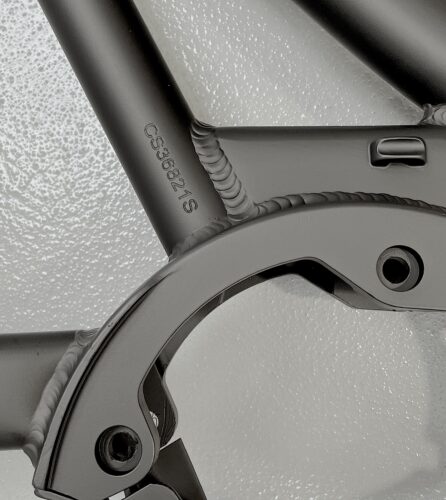
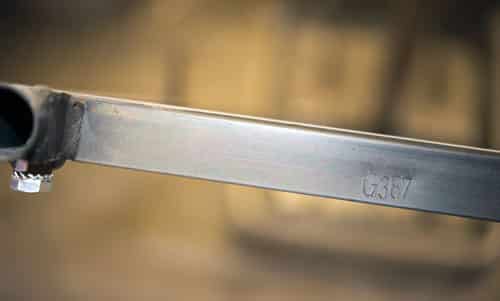
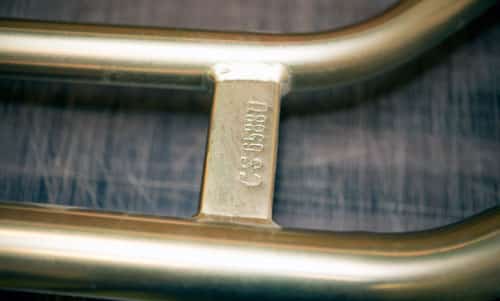
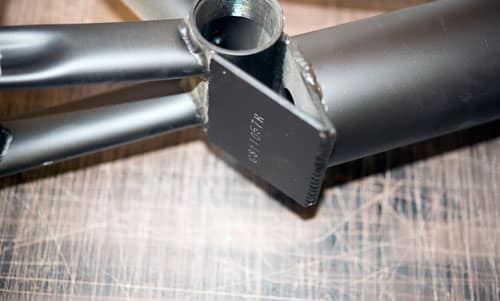
The frame number is located in different places on our cargo bikes and Trailers. On the trailers, the frame number is stamped on the side of the bottom frame. On the yellow-galvanized steel frames, we have stamped the frame number on the left side of the plate located between the top and down tubes. On aluminum frames for rearDrive models or frames for cargo bikes without a motor, the frame number is stamped on a plate beneath the bottom bracket. On midDrive aluminum frames, the frame number is stamped on the seat tube just above the motor housing.
What is the VIN?
Every bike and trailer we sell has its own unique number, known as a “ Frame Number.” Our “ Frame Number ” consists of our own manufacturer’s mark “CS,” a serial number, and a year code. We keep track of all our models using the frame number.
How old is my model?
If you send us your Frame Number, we can give you the exact date your model was manufactured. You can also find the year yourself by looking at your Frame Number. The last letter of the frame number indicates the year of manufacture. You can use the following guide to find out when your model was manufactured. The letters A–Z are used, except for I, O, and Y.
1985: A
1986: B
1987: C
1988: D
1989: E
1990: F
1991: G
1992: H
1993: J
1994: K
1995: L
1996: M
1997: N
1998: P
1999: R
2000: S
2001: T
2002: U
2003: V
2004: X
2005: Z
2006: A